Laser-Induced Periodic Surface Structures (LIPSS)
Nanostructured Surfaces for Enhanced Optical Properties
Overview
Laser-Induced Periodic Surface Structures (LIPSS) are periodic nanostructures formed on metal surfaces by femtosecond laser pulses. These structures can significantly enhance optical properties such as reflectivity, transmittance, and scattering, making them valuable for a variety of applications.
Physical Principle
LIPSS formation occurs through a combination of multiphoton absorption and plasmonic effects. The femtosecond laser pulse creates a localized plasma on the metal surface, leading to a periodic modulation of the surface topography. The periodicity and orientation of the structures depend on the laser parameters and the material properties.
Recommended CP-Series Models for This Process
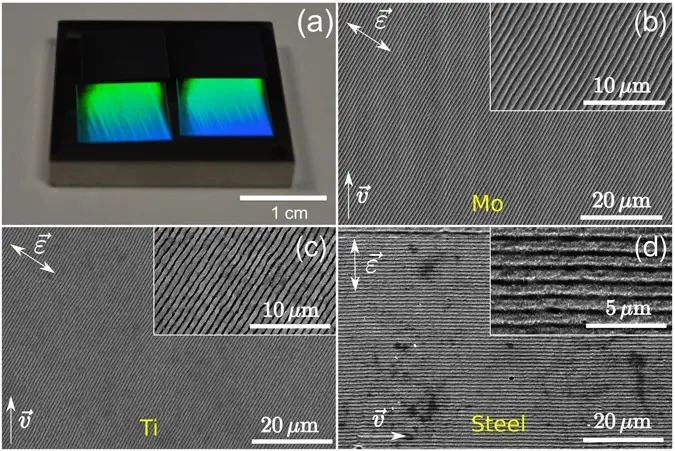
Femtosecond laser-induced periodic surface structures (LIPSS) on a gold surface. (a) Optical microscopy image showing the periodic nanostructures with a pitch of approximately 100 nm. (b) Scanning electron microscopy (SEM) image of the LIPSS, revealing the nanoscale periodicity and uniformity. The LIPSS were formed using a 800 nm femtosecond laser with a pulse energy of 100 μJ and a repetition rate of 1 kHz. Reproduced from Zhang et al., Appl. Phys. Lett. 118, 161101 (2021). © 2021 American Institute of Physics.
Technical Capabilities
Compatible Materials
Gold (Au)
High reflectivity, optical coatings
Silver (Ag)
High conductivity, plasmonic applications
Copper (Cu)
Electronics, thermal management
Aluminum (Al)
Lightweight, aerospace components
Nickel (Ni)
Magnetic properties, corrosion resistance
Titanium (Ti)
Biocompatibility, medical devices
Steel (Fe)
Durability, industrial applications
Applications
Optical Coatings
- •Anti-reflective coatings
- •High-reflectivity mirrors
- •Dielectric mirrors
Plasmonic Devices
- •Surface plasmon resonance sensors
- •Plasmonic solar cells
- •Plasmonic metamaterials
Biomedical Engineering
- •Bioactive surfaces for implants
- •Cell culture substrates
- •Tissue engineering
Energy Applications
- •Photovoltaic cells
- •Thermal management systems
- •Energy harvesting devices
Technology Comparison
| Parameter | Femtosecond Laser LIPSS | Chemical Etching | Nanoimprint Lithography |
|---|---|---|---|
| Resolution | 50-500 nm | 100-500 nm | 100-500 nm |
| Uniformity | High | Moderate | High |
| Material Compatibility | Metals and alloys | Metals | Polymers |
| Process Time | Minutes to hours | Hours to days | Hours to days |
| Environmental Impact | Minimal | Chemical waste | Minimal |
| Automation | Fully automated | Manual/semi-auto | Fully automated |
Related Application Spotlight
Ready to Implement This Process?
Contact us to discuss rental options (from €5000/month), outright purchase, or to connect with our partner network for job shop processing and process development services (paid).