Application Spotlight: Hybrid Femtosecond Laser Texturing + Hot Embossing for Hydrophobic Polymer Surfaces
A recent open-access study in Journal of Manufacturing and Materials Processing demonstrates a practical hybrid route to hydrophobic polymer surfaces: femtosecond laser texturing of stainless-steel embossing stamps followed by controlled hot embossing transfer to thermoplastics.
Why This Matters for Industrial Surface Engineering
Direct laser texturing of final polymer parts can be effective, but process robustness and economics are often challenging at production scale. The hybrid approach in this paper decouples laser structuring from part replication, enabling one textured stamp to transfer functional microfeatures repeatedly.
Process Concept
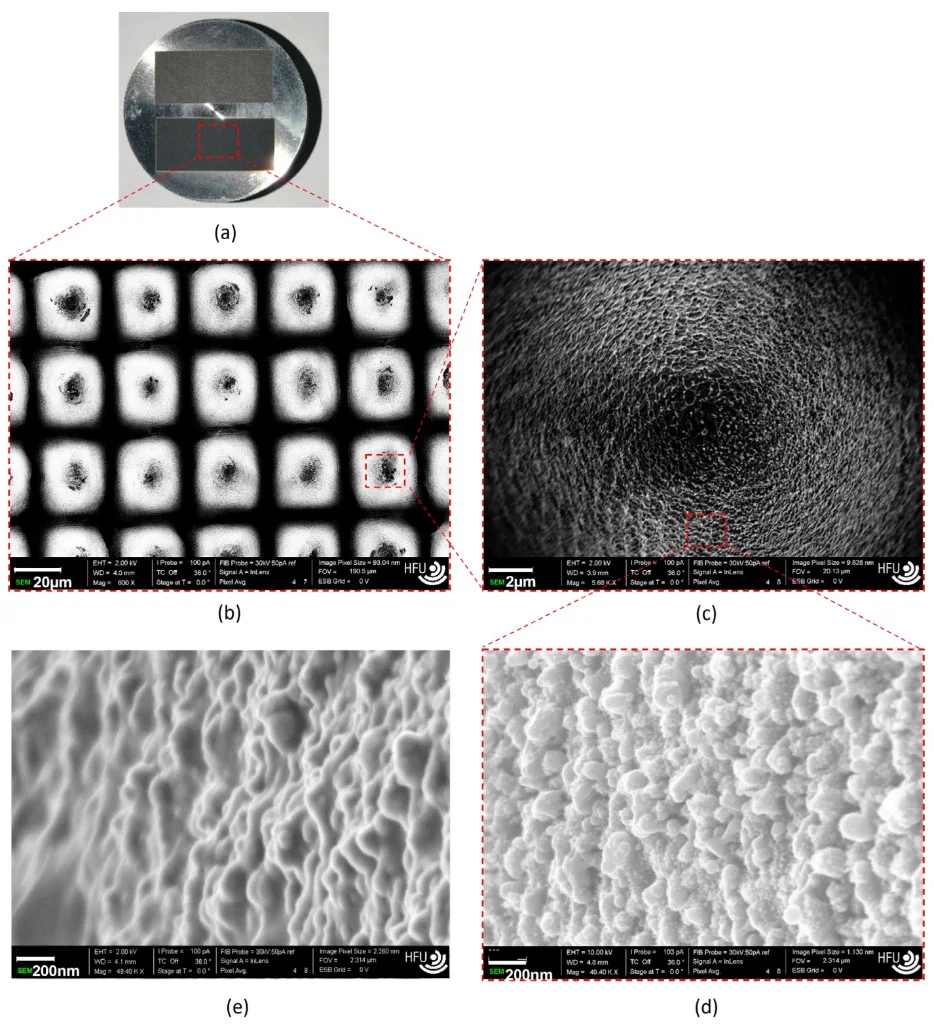
- Step 1: Texture DIN 1.4301 steel stamp surfaces using a 1064 nm femtosecond laser (750 fs class) with symmetric ball and pyramid patterns.
- Step 2: Transfer stamp microfeatures to polymers via hot embossing under controlled temperature, axial force, and 60 s holding time.
- Step 3: Validate replication fidelity and wettability via confocal metrology and contact-angle measurements.
Materials and Key Finding
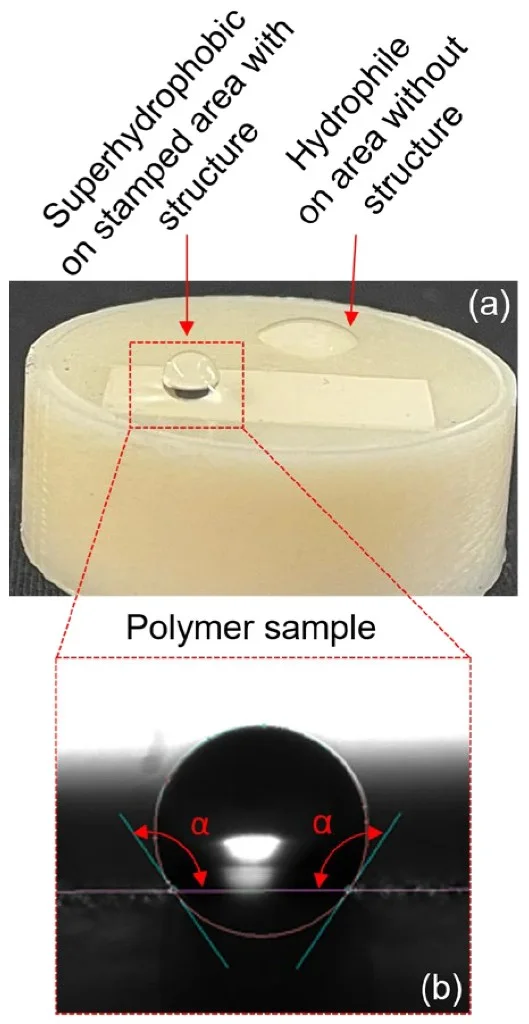
Four polymers were tested (ABS, PP, PC, PA). Within the tested parameter window, ABS and PP showed the most complete feature transfer and the strongest hydrophobic response, while PC and PA showed incomplete transfer.
The study identifies three decisive geometric features for hydrophobic performance after transfer: feature height, landing length, and width. If these exceed threshold values, hydrophobic behavior is achieved; below threshold, the surface remains insufficiently water-repellent.
Contact Angle Outcomes
- ABS: from 43.9 degrees (untextured) to 105.4 degrees (ball texture)
- PP: from 80.95 degrees (untextured) to 118.2 degrees (ball texture)
- Texture effect: The ball texture generally outperformed the pyramid texture for final contact angle in tested conditions
Micro vs Nano Features: Practical Insight
SEM analysis shows nanoscale ridge structures on the stamp after laser processing, but these nano-features flatten during embossing cycles. Despite that, hydrophobicity remained when microfeatures were preserved, suggesting micro-geometry dominates long-term functional transfer for this process chain.
Application Relevance for Clear Photon Users
This publication is highly relevant for teams building repeatable functional-surface workflows where throughput and consistency matter. It supports a scalable strategy: use femtosecond texturing to create high-value tooling, then replicate function with embossing rather than ablating every final part.
Related process context: Functional Surface Structuring and Ablation. For implementation strategy and platform selection, see CP-NEXUS and CP-VERTEX.
Reference: Zahrani, E.G.; Fakharzadeh Jahromi, A.; Azarhoushang, B. "Development of Polymer Hydrophobic Surfaces Through Combined Laser Ablation and Hot Embossing Processes." Journal of Manufacturing and Materials Processing 2024, 8(6), 262. DOI: 10.3390/jmmp8060262. Open access under CC BY 4.0.
Interested in This Application?
Contact us to learn how Clear Photon workstations can enable your research or production process.
Get in Touch