Application Spotlight: Femtosecond Laser Micro-Chainmail Scaffolds for Regenerative Medicine
Research published in Optics & Laser Technology demonstrates a breakthrough approach to regenerative medicine scaffolds: mechanically flexible micro-chainmail structures 3D printed from rigid polymer using femtosecond laser multiphoton polymerization (MPP). The work addresses critical challenges in soft tissue regeneration by combining shape-shifting architecture with high-throughput manufacturing.
The Soft Tissue Challenge
Most human tissues are mechanically soft, yet the common pre-polymers used in MPP are rigid materials with Young's modulus around 1 GPa. This creates fundamental problems:
- Material mismatch: Rigid scaffolds in soft tissue create inflammation points
- Mechanical failure: Stiff structures break post-implantation, creating potentially harmful micro-shards
- Biomaterial limitations: Soft materials typically exhibit >10% shrinkage or poor fabrication properties
- Throughput constraints: Thermal polymerization with ultrashort pulses requires low translation velocities (few mm/s)
Traditional solutions focus on developing soft biomaterials, but these often sacrifice fabrication quality, mechanical stability during multi-hour prints, or require thermal polymerization incompatible with high-speed manufacturing.
Unconventional Solution: Shape-Shifting Architecture
Instead of developing soft materials, the research team employed assembly-free movable 3D structure printing to create shape-shifting scaffolds from the well-characterized rigid pre-polymer SZ2080.
Chainmail Architecture Advantages:
- Material strategy: Exploit rigidity as advantage: individual rings maintain structural integrity while assembly provides flexibility
- Conformability: Single-layer chainmail conforms to irregular wound geometry, forming 3D scaffold structure in situ
- Functional analogy: Acts as micro-level equivalent of medical stitches
- Non-biodegradable option: Provides long-term attachment point for cells and tissue regeneration, eliminating premature scaffold degradation issues
High-Throughput Fabrication Strategy
Standard MPP printing of mm-scale structures faces severe throughput limitations. The team developed an optimized ring-by-ring fabrication approach:
Laser System (Erbium-based fiber fs oscillator):
- Wavelength: 780 nm fundamental
- Pulse duration: 100 fs (dispersion-compensated before objective)
- Repetition rate: 100 MHz (eliminates thermal accumulation, enables high-speed printing)
- Power: 20 mW at sample (near damage threshold of 22 mW for high polymerization degree)
- Objective: 0.8 NA with 300 μm × 300 μm working field
Fabrication Optimization Results (10×10 ring array):
- Non-optimized raster: 29:42 min
- Traveling salesman optimization: 7:23 min
- Ring-by-ring with high-speed galvo: 52 seconds
Key Innovation: Ring-by-ring fabrication allows exclusive use of galvo-scanners (no synchronized linear stages), enabling translation velocity increase from 1 cm/s to 10 cm/s without quality loss, a 10-fold throughput increase. Linear stages move between rings at standard 1 cm/s.
Production Scaffolds:
- Small scaffolds: 500 μm × 500 μm (10×20 rings) in ~2 minutes
- Large scaffolds: 1 mm × 1 mm (20×40 rings) in ~8 minutes
- Batch production: 40 scaffolds manufactured in just over 6 hours
This throughput enables statistically significant on-demand biotesting with MPP technology.
Ring Design Parameters
- Ring diameter: 60 μm (comparable to average cell size)
- Ring thickness: Optimized for cell-scale interaction
- Architecture: Slanted rings to maintain uniform diameter (compensates for voxel anisotropy) and prevent shadowing during sequential fabrication
- Layer configuration: Three strategically separated Z-direction parts per ring
- Surface roughness: Several hundred nm from layer-by-layer stepping, beneficial for cell adhesion
Material Characterization: SZ2080 Pre-Polymer
Two photoinitiator variations tested:
- IRG variant: 1 wt% Irgacure 369
- BIS variant: 0.5 wt% 4,4'-bis(dimethylamino)benzophenone
Material Properties:
- Shrinkage: Nominal (critical for dimensional accuracy)
- Young's modulus: ~1 GPa (fabrication parameter dependent)
- Fabrication window: Wide operational range
- Translation velocity capability: cm/s level supported
Mechanical Behavior Difference:
- IRG-based scaffolds: Highly resilient to mechanical stress, suitable for micro-spring applications
- BIS-based scaffolds: More rigid, tendency to break under mechanical stress, requires gentle manipulation
Biocompatibility Results
Three cell lines tested: immortalized rat liver (WB-F344), monkey kidney (Vero, MARC-145).
Photoinitiator Independence:
- Finding: Both IRG and BIS scaffolds showed nearly indistinguishable biocompatibility across all cell types
- Mechanism: High polymerization degree (20 mW power near 22 mW damage threshold) consumes most photoinitiator; rigid SZ2080 matrix prevents leftover molecule release (unlike swelling hydrogels)
- Implication: Photoinitiator selection can be based purely on optical absorption characteristics without biocompatibility concerns
Cell Proliferation Enhancement:
- WB-F344 cells: ~30% higher cell count on chainmail vs. flat control samples
- Vero & MARC-145 cells: Significant proliferation enhancement on chainmail scaffolds
- Mechanism: Surface roughness (hundreds of nm stepping) increases effective surface area and cell adhesion
- 3D growth: Cells colonized all ring surfaces in free-form manner, confirming true 3D scaffold functionality
Critical Finding: Flat SZ2080 samples previously performed worse than glass controls in literature, but chainmail architecture with surface topography reversed this outcome.
Scaffold Transfer & Viability
Transfer Protocol Testing:
- Procedure: Scaffolds with cells transferred from initial culture wells to fresh medium
- Cell viability post-transfer: >70% for all tested cell types
- Cell count increase: Up to 28% higher proliferation on transferred scaffolds (WB-F344)
- Ring movement impact: No adverse effects observed despite mechanical manipulation
Clinical Relevance: This mimics regenerative medicine procedure where scaffolds with cells are implanted in patient tissue. Results demonstrate that non-biodegradable hard rings moving relative to each other during implantation should not negatively impact patients.
Reusability Discovery: Some scaffolds were cleared of cells, re-seeded, and showed indistinguishable growth on second use, suggesting potential for multi-time scaffold usage in cell cultivation research.
Handling Protocol Development
Specialized protocol ensures no mechanical damage during biocompatibility testing:
- Sterilization: 96% ethanol submersion (5 min) followed by PBS washing with antibiotics
- Transfer tools: Standard 100-1000 μL pipette tips cut shorter to accommodate scaffold size
- Storage: Alcohol-filled Eppendorf tubes
- Result: High repeatability cell cultivation without breaking printed structures
Technical Insights: Throughput Optimization
Why Ring-by-Ring is Faster:
- Ring size vs. working field: 60 μm rings fit entirely within 300 μm × 300 μm field, 5× smaller
- Galvo-only operation: Fast XY scanning without synchronized linear stages
- Feedback timing limitation: Synchronized systems (48 kHz feedback, ~20 μs timing) would cause linear stage deviation before scanner correction at high speeds
- Pulse overlap advantage: 100 MHz oscillator enables 10 cm/s translation with adequate pulse overlap (100 nm spacing at 10 cm/s = 10% of 1 μm laser spot)
Repetition Rate Analysis:
- Amplified fs lasers (1 MHz): Limited to ~1 cm/s for continuous lines (10 nm pulse spacing); 10 cm/s creates 100 nm gaps
- Oscillators (100 MHz): Ceiling extends to ~100 m/s theoretical maximum (still 10 nm spacing)
- This work: 10 cm/s represents optimized balance between speed and structural quality
Medical Workflow Integration
Evolutionary rather than revolutionary implementation strategy:
- Equipment compatibility: Uses readily available laboratory tools
- Handling simplicity: Shape-shifting scaffold easier to manipulate than fragile mm-scale stiff structures
- Patch-based approach: Large chainmail sheets can be cut with standard medical scissors to required size, then conform to wound geometry
- Design flexibility: Eliminates need for patient-specific scaffold design: universal patches adapt automatically
This transitional approach provides immediate clinical applicability while opening doors for wider additive manufacturing adoption in medicine.
Multiphoton Polymerization Context
MPP technology advantages for biomedical scaffolds:
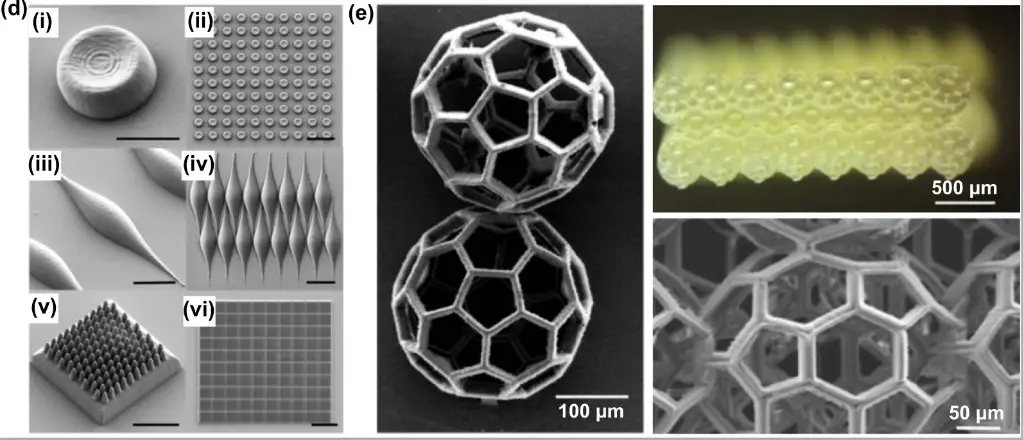
- Resolution range: Feature sizes continuously variable from hundreds of μm down to hundreds of nm (sub-10 nm with specialized methods)
- True 3D manufacturing: Volume scanning beyond layer-by-layer fabrication
- Property tuning: Polymerization degree control enables refractive index and mechanical property adjustment
- Material versatility: Wide pre-polymer selection; multi-material printing possible in single structure
Applications span photonics, microoptics, organs-on-chip, microfluidics, and micromechanics: regenerative medicine represents fastest-growing application area.
Remaining Research Questions
While results demonstrate high promise, several areas require investigation:
- Immune response: Interplay between immune reactions at lesion site and scaffold graft
- Immunocompatibility: Recipient immune system compatibility with scaffold material (critical for inorganic grafting)
- Long-term in vivo performance: Extended implantation studies needed
Future Outlook: MPP Throughput Scaling
Potential approaches for further throughput increases:
- Beam shaping: Diffractive optical elements (DOE) or spatial light modulators (SLM) for voxel shape optimization or multi-focal fabrication
- SLM limitation: Current commercial systems operate at 60 Hz; faster versions in development
- AI optimization: Advanced algorithms for scanning path optimization
- Hybrid approaches: Combining multiple methods for compound advantages
Desktop MPP systems with Class 1 safety enclosures are eliminating dedicated laser room requirements, democratizing access to precision biofabrication for standard R&D laboratories.
Reference: Jonušauskas, L., et al. "Femtosecond laser-made 3D micro-chainmail scaffolds towards regenerative medicine." Optics & Laser Technology 2023, 162, 109240. https://doi.org/10.1016/j.optlastec.2023.109240
Interested in This Application?
Contact us to learn how Clear Photon workstations can enable your research or production process.
Get in Touch