Functional Surface Structuring (LIPSS)
High-Speed Manufacturing of Highly Regular Nanostructures for Wettability & Friction Control
Overview
Laser-Induced Periodic Surface Structures (LIPSS) create sub-wavelength periodic nanopatterns on metal surfaces at industrial throughput (~1 cm² per 10 seconds). These highly regular ripples with periods close to the laser wavelength (~1 μm) dramatically alter surface properties without coatings or chemistry. Applications include anti-bacterial surfaces, drag reduction, enhanced heat transfer, anti-icing, and structural coloration for marking and aesthetics.
Physical Principle
LIPSS form through interference between the incident femtosecond laser pulse and Surface Electromagnetic Waves (SEWs) excited at the material surface. This creates a periodic modulation of absorbed laser energy, which triggers either controlled melting or nanostructure formation depending on fluence. High regularity is achieved when the Surface Plasmon Polariton (SPP) mean free path LSPP < 15 μm and the laser spot size σ is comparable to LSPP. Metals with high optical damping (high imaginary part of dielectric permittivity) exhibit the best LIPSS regularity.
Recommended CP-Series Models for This Process
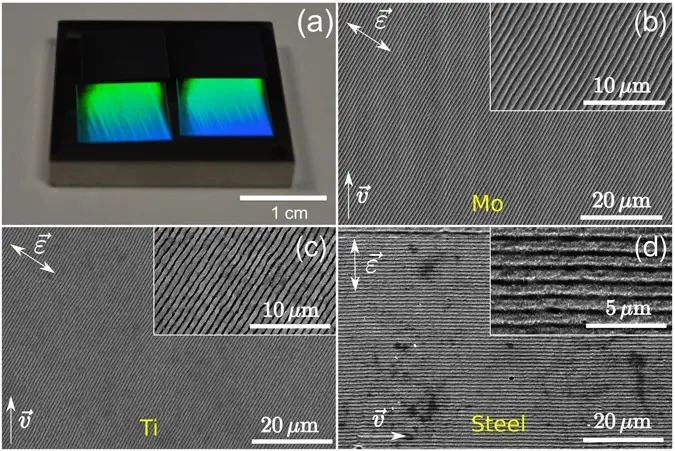
Highly regular LIPSS (HR-LIPSS) on Mo, Ti, and steel surfaces fabricated at high throughput (1 cm² per 10 seconds). (a) Human-scale view of stainless steel AISI 316L sample under ambient light showing structural coloration from diffraction (1 cm scale bar). (b) SEM of Mo surface with DLOA (dispersion in LIPSS orientation angle) δθ < 6°, the highest regularity reported in ablation regime (20 μm scale bar, inset 10 μm). (c) SEM of Ti surface with δθ < 10° (20 μm scale bar, inset 10 μm). (d) SEM of steel surface with δθ < 10° (20 μm scale bar, inset 5 μm). LIPSS period Λ ≈ 1030 nm (laser wavelength), oriented perpendicular to laser polarization. Reproduced from Gnilitskyi et al., Sci. Rep. 7, 8485 (2017). © 2017 The Authors. Licensed under CC BY (open access).
Technical Capabilities
Compatible Materials
Molybdenum (Mo)
δθ < 6°, highest regularity, LSPP = 2.9 μm
Titanium (Ti)
δθ < 10°, biocompatible, LSPP = 5.5 μm
Stainless Steel (AISI 316L)
δθ < 10°, corrosion resistant, LSPP = 14.1 μm
Chromium (Cr)
δθ = 13°, hard coatings
Nickel (Ni)
Magnetic properties, LSPP = 9.6 μm
Tungsten (W), Vanadium (V), Cobalt (Co)
Predicted HR-LIPSS candidates at λ = 1030 nm
Applications
Tribology & Wettability Control
- •Super-hydrophobic surfaces (water contact angle >150°)
- •Anti-icing surfaces
- •Drag reduction on ship hulls
- •Enhanced oil retention for lubrication
Biomedical Surfaces
- •Anti-bacterial surfaces (bacteria cannot adhere to nanoripples)
- •Cell growth direction control
- •Titanium implant osseointegration enhancement
Optical Applications
- •Structural coloration for marking (no pigments)
- •Anti-reflective surfaces
- •Diffraction gratings
- •Security features
Energy & Thermal Management
- •Enhanced boiling heat transfer (nucleation sites)
- •Solar absorber coatings
- •Thermoelectric device optimization
Technology Comparison
| Parameter | Femtosecond LIPSS (HR-LIPSS) | Nanosecond Laser LIPSS | Nanoimprint Lithography |
|---|---|---|---|
| Regularity (DLOA δθ) | < 6° (Mo) | > 20° | < 5° (mask-dependent) |
| Areal Throughput | 2.1 × 10¹⁰ μm²/h | ~10⁹ μm²/h | ~10¹¹ μm²/h (batch) |
| Period Control | 0.8-1.2 × λ | 0.5-2 × λ (variable) | Arbitrary (mask-defined) |
| Material Compatibility | Mo, Ti, Steel, Cr, Ni | Most metals | Polymers only |
| Processing Steps | Single-step | Single-step | Multi-step (mask fabrication) |
| Equipment Cost | Moderate (fs laser) | Low (ns laser) | Very high (mask + press) |
Related Application Spotlight
Application Spotlight: Femtosecond Laser Texturing of Ti-6Al-4V Surfaces
An open-access Surfaces study maps femtosecond Ti-6Al-4V texturing from ablation thresholds to a controlled 30 µm bi-sinusoidal surface aimed at implants.
Read Application SpotlightApplication Spotlight: Hybrid Femtosecond Laser Texturing + Hot Embossing for Hydrophobic Polymer Surfaces
A 2024 open-access study shows that femtosecond-textured steel stamps can transfer decisive microfeatures to ABS and PP via hot embossing, achieving contact angles up to 118.2 degrees in a scalable hybrid workflow.
Read Application SpotlightReady to Implement This Process?
Contact us to discuss rental options (from €5000/month), outright purchase, or to connect with our partner network for job shop processing and process development services (paid).