High-Contrast Marking
Black-White-Gray Marking Using Controlled Surface Structuring
Overview
Femtosecond burst-mode laser marking enables permanent high-contrast surface colorization (black, white, gray) on metals without pigments or coatings. By precisely controlling heat accumulation and surface microstructure formation, the technique creates Lambertian-scattering white surfaces and light-absorbing black surfaces on the same material. Applications include UDI marking, anti-counterfeiting, decorative patterns, and permanent part identification.
Physical Principle
White appearance is achieved through controlled surface remelting that creates specific microstructure topology: bumps/dimples with height variations >150 nm and transverse spacing <10 μm, resulting in quasi-Lambertian scattering (>70% of light scattered evenly at all angles). Black appearance results from irregular nanostructure formation with light-trapping properties. GHz-burst mode (400 ps temporal separation) and BiBurst mode (combined 400 ps + 16 ns separation) enable controlled melting vs. nanostructure formation.
Recommended CP-Series Models for This Process
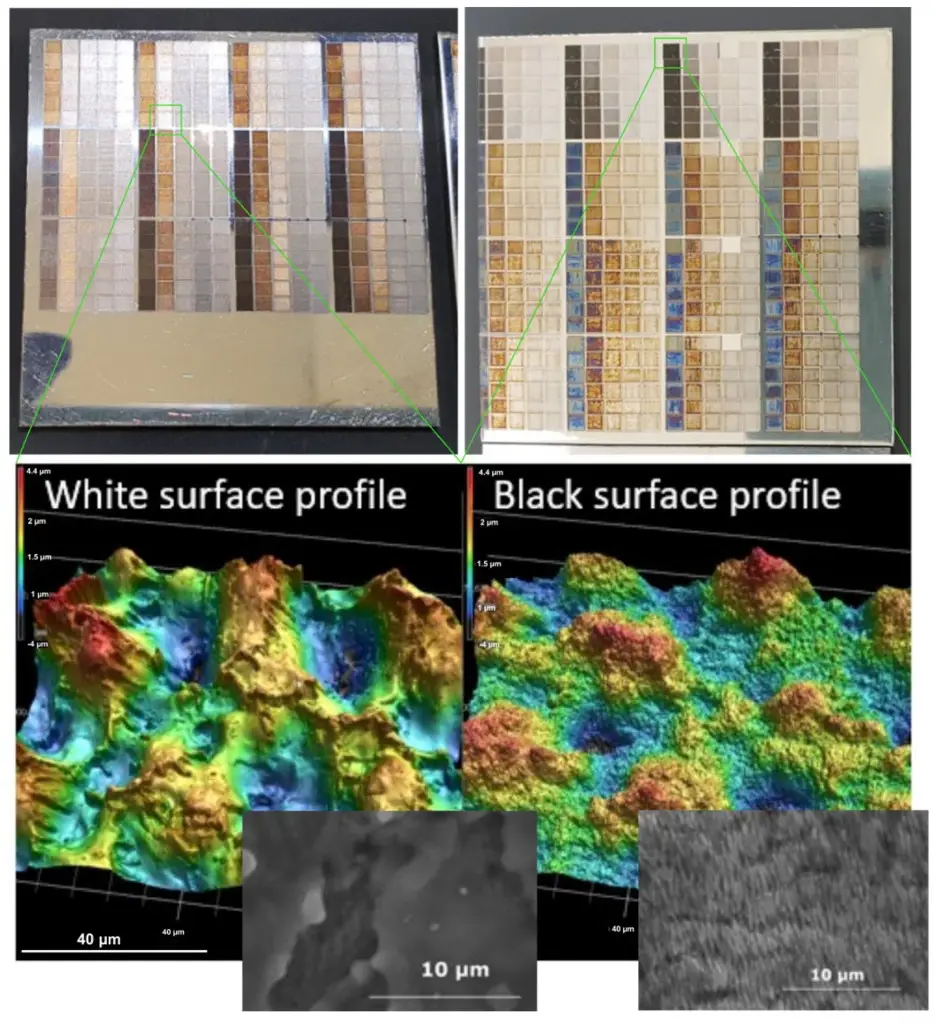
High-contrast marking of stainless steel (AISI304) using femtosecond burst-mode laser. Top row: Optical images showing array of test squares with different laser parameters producing white, gray, and black surfaces. Bottom row: 3D laser microscope surface profiles of white and black marked regions (40 μm scale bar), with inset SEM images (10 μm scale bar) showing microstructured remelted surface for white marking and irregular nanostructures for black marking. The white surface exhibits quasi-Lambertian scattering with >70% light scattered evenly across all viewing angles. Reproduced from Butkus et al., Micromachines 2023, 14(1), 194. © 2023 by the authors. Licensed under CC BY 4.0.
Technical Capabilities
Compatible Materials
Stainless Steel (AISI304, 316L)
Medical devices, luxury goods, UDI marking
Titanium and Ti alloys
Implants, aerospace components
Aluminum
Consumer electronics, automotive parts
Copper
Electronics, decorative applications
Tool Steel
Mold & die identification
Applications
Medical Device Manufacturing
- •UDI (Unique Device Identification) marking on implants
- •Permanent serial numbers on surgical instruments
- •Anti-counterfeiting marks on medical equipment
Luxury Goods & Consumer Products
- •Brand logos on watches and jewelry
- •Decorative patterns on stainless steel
- •High-contrast QR codes and barcodes
Automotive & Aerospace
- •Part traceability marking
- •Serial numbers on safety-critical components
- •Permanent VIN marking
Security & Anti-Counterfeiting
- •Covert security marks
- •Tamper-evident patterns
- •Authentication features
Technology Comparison
| Parameter | Femtosecond Burst Marking | Nanosecond Laser Marking | Chemical Etching |
|---|---|---|---|
| Color Range | Black-Gray-White | Black-Dark Gray | Limited |
| Viewing Angle Dependence | None (Lambertian) | Moderate | None |
| Mechanism | Controlled micro/nanostructuring | Oxide layer formation | Chemical reaction |
| Durability | Permanent (wear-resistant) | Good (can fade) | Moderate |
| Process Time (2mm × 2mm) | < 1 minute | < 30 seconds | Minutes to hours |
| Environmental Impact | Minimal | Minimal | Chemical waste |
Related Application Spotlight
Ready to Implement This Process?
Contact us to discuss rental options (from €5000/month), outright purchase, or to connect with our partner network for job shop processing and process development services (paid).