Overview
Ultrashort pulse laser polishing achieves mirror-like surface finishes through controlled surface melting and re-solidification. Unlike conventional USP laser processing which aims for ablation, USP polishing uses heat accumulation at high repetition rates (48.92 MHz) to create a thin molten surface layer. Surface tension redistributes material from peaks to valleys, achieving optical-quality finishes without traditional abrasive processes.
Physical Principle
At high repetition rates (MHz range), the temporal pulse distance (20.4 ns at 48.92 MHz) is too short for complete heat dissipation between pulses. This controlled heat accumulation creates a continuously remelted surface layer with a process temperature between melting and evaporation points. The melt pool depth is precisely controlled by fluence, scan speed, and beam diameter. Typical remelted layer thickness: 1-10 μm with heat-affected zone (HAZ) extending beneath.
Recommended CP-Series Models for This Process
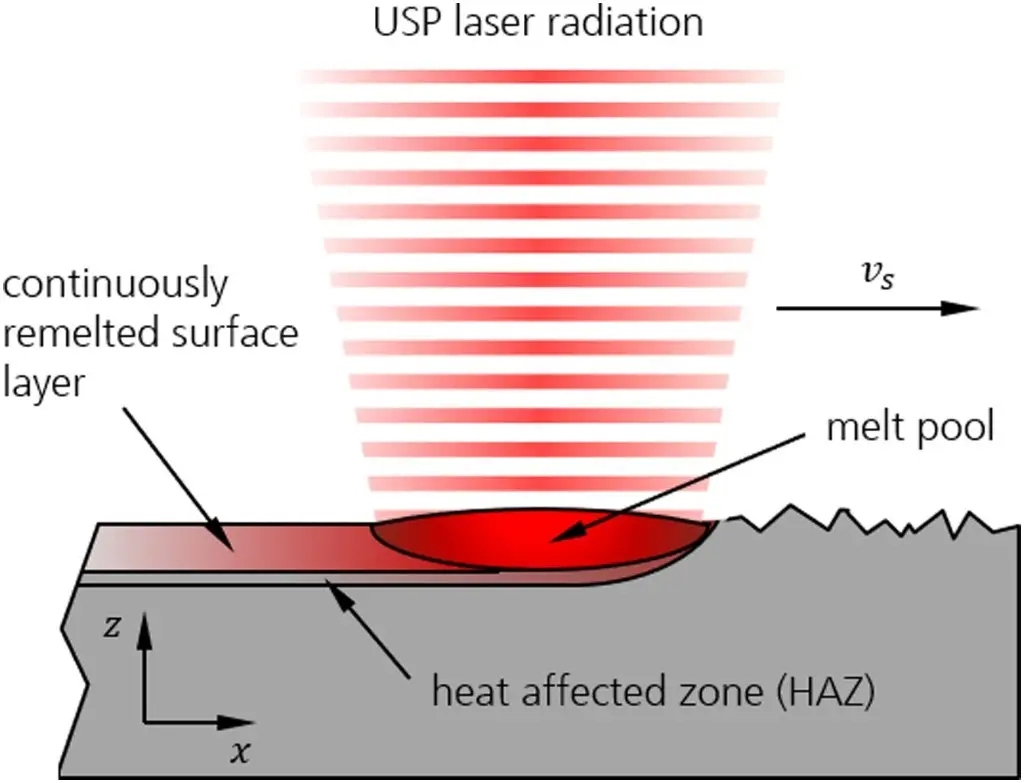
Schematic process principle of USP laser polishing by continuous surface melting. USP laser radiation at high repetition rate (48.92 MHz) scans across the surface with velocity vs, creating a continuously remelted surface layer and underlying heat affected zone (HAZ). The melt pool is maintained between melting and evaporation temperature, enabling surface tension-driven smoothing. Reproduced from Sassmannshausen et al., J. Mater. Process. Technol. 293, 117058 (2021). © 2021 The Authors. Published by Elsevier under CC BY license.
Technical Capabilities
Compatible Materials
Tool Steel (1.2738)
Sa 0.6 → 0.3 μm, mold and die applications
Stainless Steel
Medical instruments, jewelry, Sa reduction >50%
Titanium Alloys (Ti6Al4V)
Implants, aerospace components
Inconel 718
Sa 0.435 → 0.127 μm under argon atmosphere
Aluminum
Optical mounts, reflectors
Applications
Mold & Die Manufacturing
- •Injection mold micro-polishing
- •3D laser-structured surfaces finishing
- •Complex cavity smoothing after laser ablation
Medical Device Manufacturing
- •Surgical instrument polishing
- •Implant surface finishing
- •Stent polishing
Luxury Goods
- •Watch component finishing
- •Jewelry polishing
- •Premium surface aesthetics
Photonic Process Chain
- •Same-machine structuring + polishing
- •Automated surface finishing
- •LED and optical component finishing
Technology Comparison
| Parameter | USP Laser Polishing (fs, MHz) | Conventional Laser Polishing (ns-μs) | Mechanical Polishing |
|---|---|---|---|
| Pulse Duration | 800 fs | 110 ns - 5 μs | N/A |
| Repetition Rate | 48.92 MHz | < 1 MHz | N/A |
| Melting Depth | 1-10 μm | < 5 μm (micro) / 10-100 μm (macro) | Surface only |
| Roughness Reduction | Sa 0.6 → 0.3 μm | Sa varies | Sa 0.2-1 μm |
| Process Time | 12.15 cm²/min | Slower | Hours |
| Consumables | None | None | Abrasives required |
| Automation | Fully automated | Automated | Manual/semi-auto |
Ready to Implement This Process?
Contact us to discuss rental options (from €5000/month), outright purchase, or to connect with our partner network for job shop processing and process development services (paid).