Application Spotlight: High-Quality CFRP Micro-Hole Drilling with Spatially Modulated Femtosecond Laser
A new study in Precision Engineering presents a practical route to precision drilling of carbon fiber reinforced polymer (CFRP) using spatially modulated femtosecond laser processing. The key contribution is a liquid-crystal spatial light modulator (LC-SLM) workflow that enables controlled 3D focus steering and significantly lower hole taper than conventional approaches.
Why CFRP Micro-Drilling Is Hard
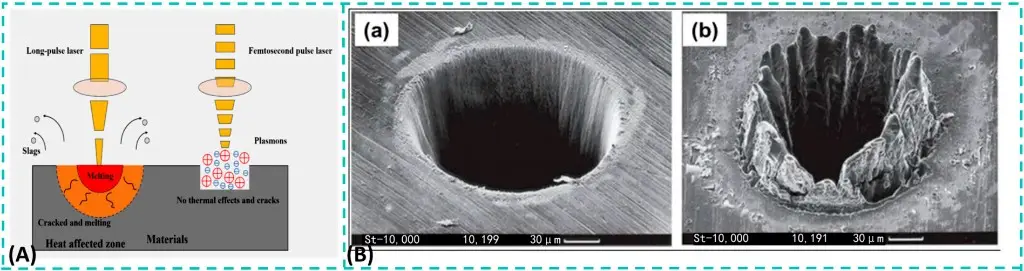
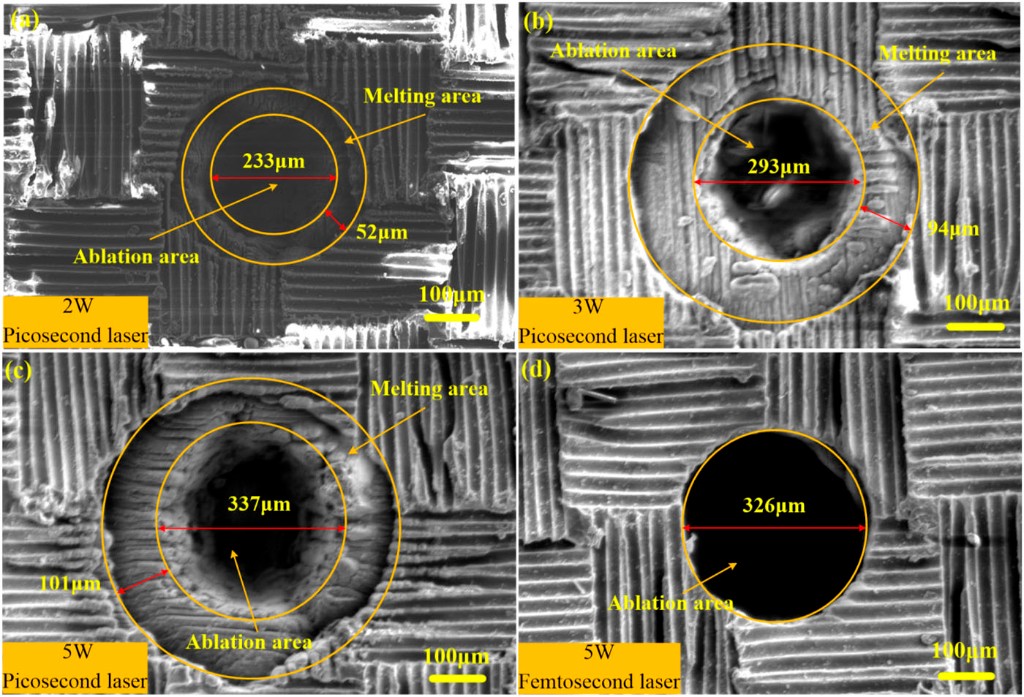
CFRP combines high stiffness, low weight, and chemical resistance, but its anisotropic fiber-resin structure makes precision drilling difficult. Traditional methods can induce delamination, tearing, microcracks, and poor edge quality. Even laser drilling may suffer from excessive taper, heat-affected zone (HAZ), and geometric inconsistency if process parameters are not carefully tuned.
Core Technical Idea: SLM-Based Optical Field Control
The authors use an LC-SLM to shape the femtosecond beam with phase holograms that combine a blaze grating and Fresnel lens phase. This enables:
- Axial focus control (z): dynamic refocusing through Fresnel phase loading
- Radial focus control (x-y): spot steering through grating phase modulation
- Better energy placement: more uniform material removal through depth
A 4F system is used to suppress zero-order light and improve usable beam quality at the workpiece.
Experimental Setup Snapshot
- Material: 500 um laminate CFRP (M55 fiber / BS-4 epoxy), stacking 0/+45/90/-45
- Laser: Ti:sapphire regenerative system, 800 nm, 50 fs, up to 1000 Hz
- Motion: nanometer-scale 3D stage
- Metrology: SEM, confocal and optical microscopy
Parameter Effects That Matter Most
The paper systematically evaluates laser power, spot overlap, scan pitch, feed distance, and scanning strategy, then uses response surface methodology (Box-Behnken) for optimization.
- Laser power: the strongest statistical effect on taper (p = 0.0006)
- Spot overlap: around 0.36 gives a strong balance of removal quality and thermal control
- Axial feed: too large increases taper by reducing effective deep-layer fluence
- Scan strategy: inward-to-outward radial paths produced lower taper than outward-to-inward in tested conditions
Best Reported Result
With response-surface-guided parameters and a copper foil sacrificial layer, the team reports:
- Roundness: 2.9 um
- Taper angle: 0.716 degrees
- HAZ: approximately 4 um at the outlet region
This is a strong improvement versus pre-optimization baseline values and supports the claim that optical-field control + statistical optimization can materially improve CFRP micro-hole quality.
Why This Is Industrially Relevant
For aerospace and high-reliability composite assemblies, lower taper and cleaner sidewalls directly reduce rework and improve dimensional consistency. The method is also compatible with future throughput upgrades such as SLM-enabled multi-beam parallelization, which the authors identify as a next step.
Takeaway for Process Engineers
This work reinforces a practical message: in CFRP femtosecond drilling, beam-shaping architecture and scanning strategy are as important as raw pulse parameters. If your KPI is low taper with controlled HAZ, SLM-based 3D focal control combined with response-surface optimization is a credible path to production-ready process windows.
Reference: Yuan, Y., Qiao, Y., Li, D., Zhang, K., Han, W. "High-quality micro-hole drilling and optimizing on CFRP by spatially modulated femtosecond laser." Precision Engineering (2026). https://doi.org/10.1016/j.precisioneng.2026.03.014
Interested in This Application?
Contact us to learn how Clear Photon workstations can enable your research or production process.
Get in Touch