Femtosecond Laser Drilling in Sapphire: Achieving High-Aspect-Ratio Microstructures
A comprehensive review article published in Materials journal examines recent advances in femtosecond laser processing of sapphire (α-Al₂O₃), one of the hardest and most chemically stable materials available. By synthesizing findings from multiple research groups, this review demonstrates how ultrashort laser pulses enable precision micromachining impossible with traditional methods.
Why Sapphire is So Challenging
Sapphire presents extraordinary difficulties for conventional machining:
- Extreme hardness: Mohs hardness of 9, Vickers hardness ~2200 kg/mm²
- High melting point: 2045°C
- Chemical inertness: Resists most acids and bases at room temperature Brittleness: Prone to microcracking with mechanical tools
Traditional mechanical drilling and chemical-mechanical polishing fail to meet requirements for micro and nanoscale sapphire structures.
The 'Cold Ablation' Breakthrough
Femtosecond lasers operate in a fundamentally different regime than conventional lasers. The key physics:
- Pulse duration: 10⁻¹⁵ seconds (femtoseconds) - shorter than heat diffusion time
- Energy deposition: Occurs before thermal diffusion to the lattice
- Material removal mechanism: Direct transition from solid to plasma state
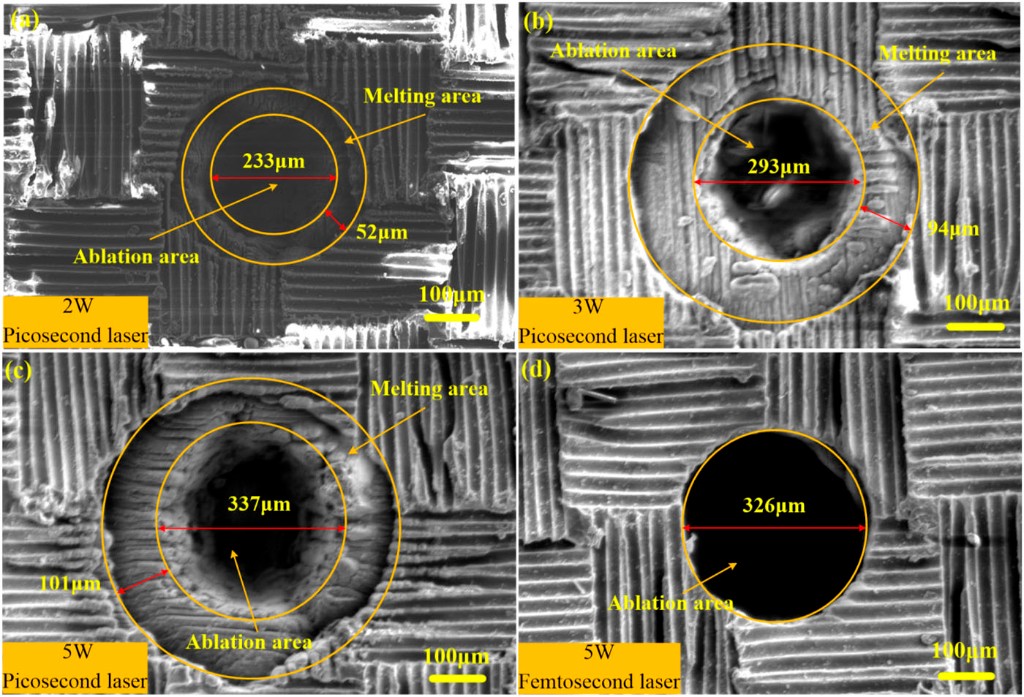
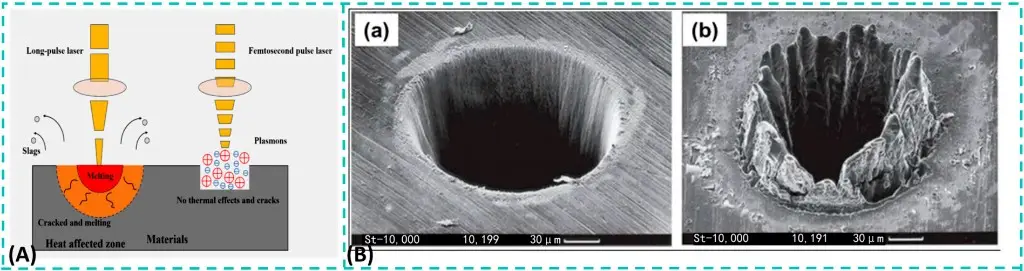
- Result: Minimal heat-affected zone (HAZ < 1 μm) vs. 100-400 μm for nanosecond lasers
This 'cold processing' characteristic prevents microcracks and remelted layers that plague traditional sapphire machining.
Precision Thresholds & Bidirectional Drilling
Achieving crack-free structures requires masterful control of laser physics. Recent studies highlight two major breakthroughs in this area:
- Establishing the 'Cold' Window: Li et al. quantified exact ablation thresholds, finding ~4.5 J/cm² at 800 nm with 45 fs pulses. They proved that shorter wavelengths (400 nm) produce even finer ablation pits with lower energy requirements.
- Crack-Free Through-Holes: Cai et al. demonstrated a novel bidirectional drilling technique. By precisely controlling the defocus distance and pulse energy, they successfully suppressed the formation of anomalous regions and microcracks deep within the material.
High-Aspect-Ratio Capillaries
Zhang et al. achieved remarkable results using energy-as-a-function-of-depth compensation:
- Strategy: Linearly increasing pulse energy with drilling depth
- Achievement: Enhanced roundness and depth uniformity in sapphire capillaries
- Application: Critical for microfluidic channels and fiber optic components
Extreme Aspect Ratios: 10:1 Microgrooves
Liu et al. combined plasma-assisted ablation with direct ablation to achieve:
- Aspect ratio: 10:1 (depth to width)
- Quality: Crack-free microgrooves
- Innovation: Coordination of multiple ablation mechanisms with dynamic parameter control
Critical Process Parameters
Achieving high-quality sapphire drilling requires precise control of multiple parameters:
- Wavelength: Shorter wavelengths (400 nm) produce finer features than 800 nm
- Pulse energy: Must stay just above ablation threshold to avoid thermal effects
- Repetition rate: High rates improve efficiency but risk thermal accumulation
- Scanning speed: Controls pulse overlap and thermal management
- Focus position: Dynamic adjustment critical for deep drilling
Advanced Applications Now Possible
These femtosecond laser capabilities enable entirely new sapphire-based devices:
- High-pressure sensors: All-sapphire optical fiber pressure sensors for extreme environments
- Microfluidic reactors: High-temperature chemical reactors with complex 3D channel networks
- Aerospace components: Sapphire windows and sensor housings with integrated microstructures
- Medical devices: Biocompatible implants and surgical tool components
- LED substrates: Micro-patterned sapphire substrates (PSS) for enhanced light extraction
Beyond Simple Drilling: Hybrid Processing
Researchers are now combining femtosecond laser modification with chemical etching (Selective Laser Etching - SLE):
- Two-step process: Laser creates modified zones, then chemical etching removes them selectively
- Extreme aspect ratios: Up to 80:1 achieved by Liu et al. using this hybrid approach
- High throughput: Jiang et al. demonstrated 4000 microholes per second
- Complex 3D structures: Pyramidal and tetrahedral micro/nanostructures by Xie et al.
Industrial Readiness
While femtosecond laser sapphire processing offers unmatched precision, current challenges include:
- Processing speed: Lower than mechanical methods for large-scale components
- Equipment cost: Higher capital investment than traditional tools
- Expertise required: Demands precise parameter optimization
However, for applications requiring:
- Micro and nanoscale features
- Zero thermal damage
- Complex 3D geometries
- High-quality edge finish
Femtosecond laser processing is becoming the only viable solution.
The Desktop Revolution
Historically, femtosecond laser systems required dedicated laser safety rooms and expert operators. New desktop workstations now bring this capability to standard R&D laboratories:
- Class 1 safety enclosures: No special room requirements
- Integrated systems: Laser source, motion control, and vision systems in one platform
- Accessible pricing: Democratizing access to ultrafast laser micromachining
Reference: Liang, C., et al. "A Review of Femtosecond Laser Processing for Sapphire." Materials 2026, 19(1), 206. https://doi.org/10.3390/ma19010206
Interested in This Application?
Contact us to learn how Clear Photon workstations can enable your research or production process.
Get in Touch