Application Spotlight: Femtosecond Glass-to-Metal Welding: What Makes the Joint Strong
An open-access study in Nanomaterials presents a comprehensive look at femtosecond laser direct welding of glass and metal. The authors optimize pulse energy, focal position, and line spacing, then compare beam shaping and material pairs, including borosilicate, fused silica, and Zerodur glasses with mirror-polished Cu, Mo, Al, Ti, and AISI316 steel. The work is framed as guidance for glass-to-metal welding in various industrial applications.
Why Direct Glass-to-Metal Bonds Are Hard
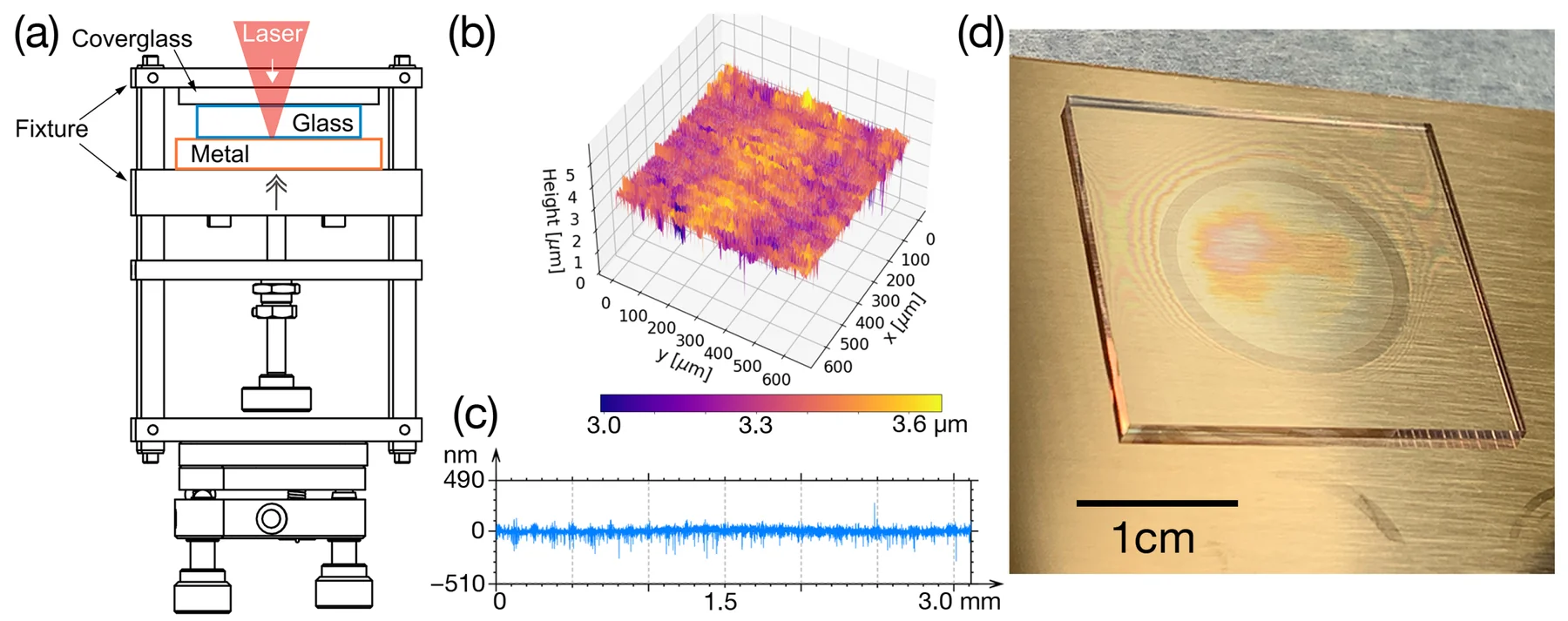
Glass and metal differ sharply in thermal expansion, conductivity, and damage threshold. In Part I of the same series, the group found that an air gap of about 1.5 µm already limits successful welds for borosilicate glass. Here they press mirror-polished metals (typical Ra 19.3 nm) against the glass in a clamping fixture until first-order Newton rings cover the weld area, so the residual gap is far below that critical value. Process parameters can then be compared on a more even footing.
Laser Conditions Used in the Study
Welding used a 1030 nm, 400 fs source. Early parameter maps used bursts of 8 pulses at 125 kHz. Later beam-shape and material-pair tests used 4 pulses per burst at 330 kHz, still with 20 ns between pulses inside the burst. Focusing was either NA 0.26 or NA 0.10, with an optional spiral phase plate for a vortex beam.
Parameters That Move Strength
- Pulse energy: breaking force rises to an optimum and then falls. For fused silica on copper it dropped to 0 N at 6.05 µJ, because absorption shifted into the glass bulk and the interface modification was suppressed.
- Focus position: maximum breaking force was similar with the focus at the glass-metal interface (0 µm) and 40 µm into the metal (−40 µm). The interface focus reached that force at lower pulse energy; the defocused case needed higher energy for a similar force.
- Line spacing: denser hatching raises total strength (12.7 MPa at 10 µm spacing over the reported weld area), but each individual line contributes less, so process efficiency drops.
- Beam shape: under tight focusing (NA 0.26) a vortex beam raised maximum breaking force by 61% versus Gaussian. Under loose focusing (NA 0.10) the gain was only 4%. The authors caution that part of the vortex benefit tracks the larger effective beam area: a loosely focused Gaussian reached 82.0 N versus 82.3 N for the tightly focused vortex.
Which Material Pairs Work Best
Across borosilicate, fused silica, and Zerodur paired with Cu, Mo, Al, Ti, and AISI316, weldability varied strongly:
- Best force: fused silica to molybdenum reached 102.4 N, the highest value among the tested pairs.
- Strong borosilicate case: borosilicate to copper reached 85.12 N.
- Hard partners: stainless steel AISI316 and titanium were the weakest counterparts for borosilicate and fused silica.
- Zerodur advantage: near-zero-expansion Zerodur bonded to all tested metals, reaching 72.7 N with AISI316.
A time-dependent finite-element model linked the steel result to heat transport: peak thermal stress was about 76 to 78 MPa for fused silica on Cu, Al, or Mo, versus about 1801 MPa on AISI316, attributed to the steel's low thermal conductivity.
Practical Watch-Outs
- Close contact first: without gap control, strength scatter can hide every other process effect.
- Energy has a ceiling: too much pulse energy can move absorption into the glass and erase the interface weld.
- Focus at the interface saves energy: 0 µm and −40 µm reached similar peak force, but the interface focus did so at lower pulse energy.
- Hatch denser, but slower: tighter spacing can raise total strength while reducing force per line.
- Treat forces as lower bounds: the authors note that most breaking forces are single measurements and should be read as lower bounds on reachable strength.
Related Clear Photon Pages
For process context, see Laser Welding. Our earlier burst-mode micromachining overview called glass welding comparatively underexplored; this Nanomaterials study is a concrete example of that frontier. If you already have an ultrafast source, start with BYOL Laser Integration or Process Development.
Source: Li, Q.; Luo, F.; Matthäus, G.; Sohr, D.; Nolte, S. "Direct Glass-to-Metal Welding by Femtosecond Laser Pulse Bursts: II, Enhancing the Weld Between Glass and Polished Metal Surfaces." Nanomaterials 2025, 15(16), 1215. DOI: 10.3390/nano15161215. Open access under CC BY 4.0. The hero figure is reproduced from Figure 1 of the source under CC BY 4.0, with no content changes other than resizing and file-format conversion for web delivery. Part I of the series (welding with an air gap) is Nanomaterials 2025, 15, 1202.
Interested in This Application?
Contact us to learn how Clear Photon workstations can enable your research or production process.
Get in Touch